
Thanksgiving Day, one of the most cherished holidays in the United States, has long been equated with family reunions, feasting, recollection of life’s blessings, and a healthy dose of football to boot. It is a time for looking back in gratitude, acknowledging our dependence on God’s goodness and giving Him thanks for sustaining us through the year. But what is the true origin of Thanksgiving? And why should we as Catholics be thankful to God, no only on Thanksgiving, but every day of the year?
As Thanksgiving Day approaches, we would do well to remember the religious foundation on which our nation was built and the Christian traditions that have colored our history from the beginning. It is good to call to mind all we have received from God, for in order to be thankful, we must have knowledge of what we have been given
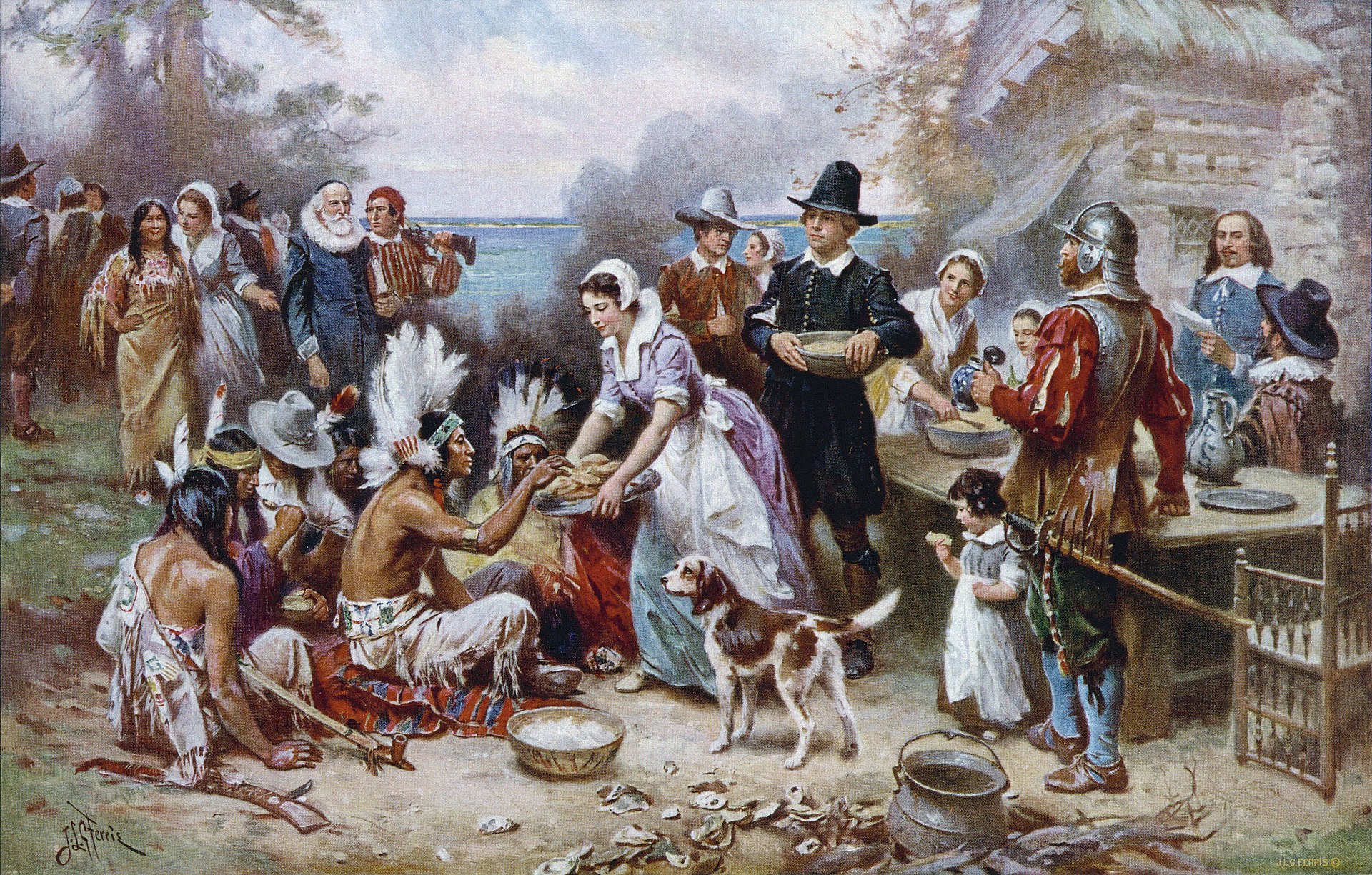
Why do We Celebrate Thanksgiving Day?
Lesson Overview
Upper Elementary Lesson Materials
Download all PDFsIn this lesson your students will:
- Explore what the Catechism of the Catholic Church teaches about man’s inclination
to give thanks to God. - Understand how the Eucharist is the perfect expression of thanksgiving.
- Learn the story of the first Thanksgiving Mass in America.
- Consider ways we can truly celebrate Thanksgiving Day this year.
Resources:
- “Thanksgiving Day,” Encyclopedia Britannica:
SophiaOnline.org/ThanksgivingDay - “The first Thanksgiving in America was a Catholic Mass,” Aleteia:
SophiaOnline.org/FirstThanksgiving
Activities:
Catechism of the Catholic Church nos. 1146, 1360, 1333 & 2638
- First, have your students read Catechism of the Catholic Church nos. 1146, 1360, 1333 & 2638.
- Next, have them complete the focus and reflection questions.
- When your students have completed the focus and reflection questions, review and discuss the correct answers.
Thanksgiving Day in America
- Have your students read the Encyclopedia Britannica article “Thanksgiving Day,” found at the following link: SophiaOnline.org/ThanksgivingDay. Then, have them read the article from Aletiea.org “The first Thanksgiving in America was a Catholic Mass,” found at the following link: SophiaOnline.org/FirstThanksgiving.
- Next, arrange your students into groups of three or four. Have them compare and contrast the articles using the discussion questions from the handout Thanksgiving Day in America.
- When groups have finished discussing, call on groups to share and discuss with the class key points from their conversation. Lead a discussion on how our own Thanksgiving traditions relate to what the Catechism teaches.
Answer Key
Catechism of the Catholic Church no. 1146, 1360, 1333 & 2638
- The Catechism states: “As a being at once body and spirit, man expresses and perceives spiritual realities through physical signs and symbols. As a social being, man needs signs and symbols to communicate with others, through language, gestures, and actions. The same holds true for his relationship with God” (CCC 1146). Accept reasoned answers.
- The Church expresses her gratitude to God primarily through the Sacrifice of the Eucharist, which is Christ’s own offering to the Father, re-presented at the altar for our good and the good of the whole Church. The very word “Eucharist” means “thanksgiving.”
- “At the heart of the Eucharistic celebration are the bread and wine that, by the words of Christ and the invocation of the Holy Spirit, become Christ's Body and Blood. …The signs of bread and wine become, in a way surpassing understanding, the Body and Blood of Christ; they continue also to signify the goodness of creation” (CCC 1333). As “fruit of the earth, and work of human hands,” the bread and wine are our offering to God, which will be made acceptable to Him by the action of Christ Himself, working through the priest. We have nothing of our own, for all that is good comes from God; yet by His grace we can cooperate with Him, taking what is His own (grain and grapes), cultivating it, and offering it back to Him (as bread and wine). During the consecration at Mass, Christ takes this meager offering and makes it perfect and acceptable to God as a sacrifice for our salvation.
- St. Paul says that we should "Give thanks in all circumstances; for this is the will of God in Christ Jesus for you"; "Continue steadfastly in prayer, being watchful in it with thanksgiving" (CCC 2638).
- Accept reasoned answers. Examples include handshakes, cards, hugs, gifts, flowers, lending a helping hand, cooking a meal, sharing something with another, etc.
- Accept reasoned answers. Examples include Eucharistic Adoration, Liturgy of the Hours, processions, private devotions, the Corporal and Spiritual Works of Mercy, Baptism, feast days, through evangelization, etc.
- Accept reasoned answers.
- Accept reasoned answers. God’s goodness is expressed in the bounty of the Thanksgiving feast, in the gathering of family, the sharing of goods, a meal, and fellowship. We can express our gratitude to Him by offering prayers as a family, attending Mass, remembering the blessings we have received throughout the year, cultivating a grateful heart, performing the Corporal and Spiritual Works of Mercy, and reflecting His love in our lives with our family and friends.
Thanksgiving Day in America
- President Franklin D. Roosevelt briefly moved Thanksgiving Day to the third week in November in an effort to extend the Christmas shopping season and boost the economy. Accept reasoned answers.
- The article states: “The holiday associated with Pilgrims and Native Americans has come to symbolize intercultural peace, America’s opportunity for newcomers, and the sanctity of home and family.” Accept reasoned answers.
- Father Francisco Lopez, the Chaplain of the ships of the first Spanish settlers. He celebrated a Mass of thanksgiving for a safe arrival in what is now Florida, in September 1565–50 years before the events surrounding Plymouth Plantation.
- Accept reasoned answers.
- Accept reasoned answers.
- Accept reasoned answers.
- The primary way we offer thanks to God is in the celebration of the Holy Eucharist, which is Christ’s own offering of Himself to the Father for our salvation, re-presented on the altar at every Mass.
- Yes, it is. Everything we have, even our very lives, is a free and loving gift from God. If we realize that we are totally dependent on God at every moment in our lives, and that He showers us with blessings and wonderful gifts, our only response can be one of thankfulness and sincere gratitude. The Catechism, quoting St. Paul, underscores the necessity of thanksgiving in the Christian life: "Give thanks in all circumstances; for this is the will of God in Christ Jesus for you"; "Continue steadfastly in prayer, being watchful in it with thanksgiving."
- Accept reasoned answers.
