
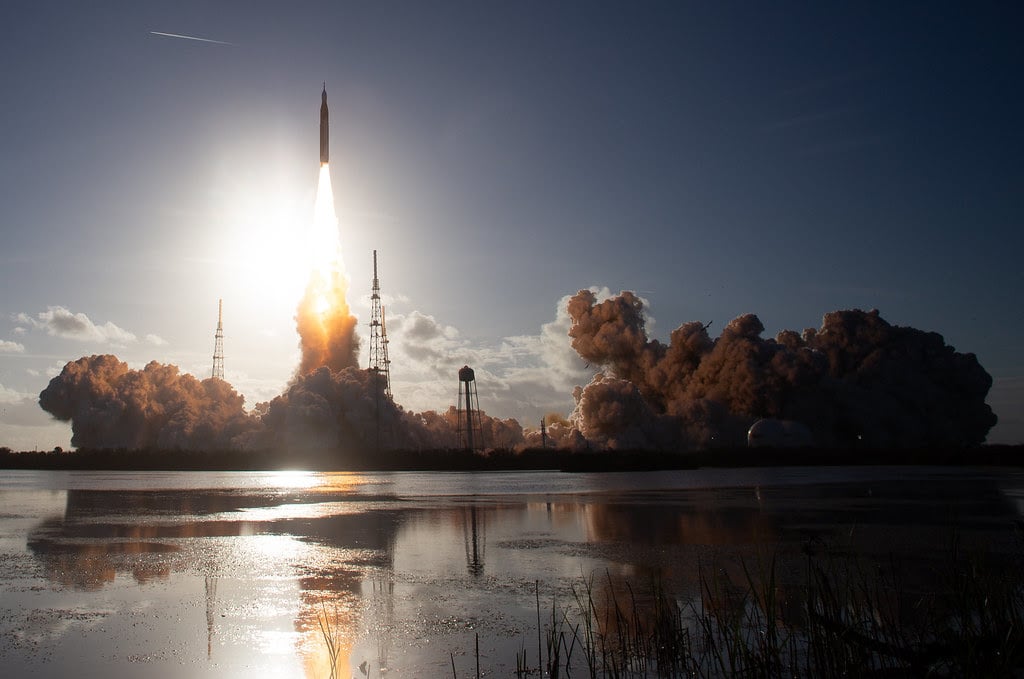
On April 1, 2026, the four astronauts of Artemis II rocketed into space for a ten-day lunar flyby mission, becoming the first human beings in more than 50 years to fly to the moon’s vicinity. These four men and women also became the first human beings to travel beyond low earth orbit since 1972, and, as they looped around the dark side of the moon, travelled further from earth than any human beings have before.
Dramatic explorations of new frontiers like the Artemis II mission capture the hearts and imaginations of the world. They give us the chance to reflect on our place in the universe, our relationship to God and to one another, and to marvel at the wonders of His creation and what they reveal about Him and His divine providence.
In this lesson, your students will:
- Reflect on the Artemis II lunar flyby mission.
- Contemplate the natural human desire for God present deep in our hearts.
- Consider how trying to see things from God’s perspective sheds new light on challenging human experiences.
- Reflect on how the wonders of the universe glorify God.
Activity
A. Show your class the video overview of the Artemis II mission titled “Artemis II to the Moon: Launch to Splashdown” found at SophiaOnline.org/ArtemisIIVideo. This eight-minute video engagingly discusses the events of the mission from its preparation stages, to launch, to what happens in space and how the crew gets to the moon and back.
B. Project the images below and give students a few moments of silence to contemplate them. Explain that the first photo, taken by the Artemis II crew, is of the moon fully eclipsing the sun. From the crew’s perspective, they experienced over 50 minutes of totality, and witnessed, a glowing halo around moon, as shown in the picture. Scientists are, as yet, uncertain about what exactly caused the halo. The faint glow on the lift side of the moon in the image is light reflecting off the earth. The tiny pinpoints of light are stars seen from this unique vantage point, which are usually not usually seen when imaging the moon.
C. The second photo, also taken by the Artemis II crew, is of the surface of the moon in stunning detail in the immediate foreground with the Earth setting in the distant background. The portion of the Earth in darkness is experiencing nighttime, while it is daytime in the portion in light (Australia and Oceania).
D. For homework, encourage students to explore the official NASA Artemis II Multimedia website, found at SophiaOnline.org/ArtemisIIMultimedia, with their parents. This site is full of images and resources to help bring the Artemis II mission to life.
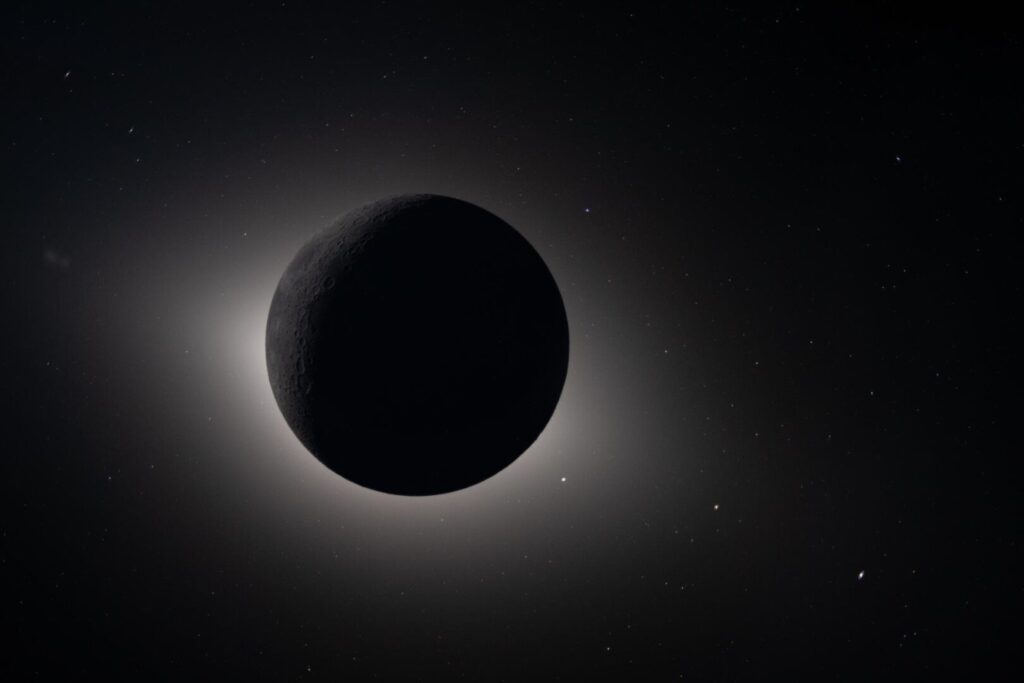
Image by Artemis II crew (2026)
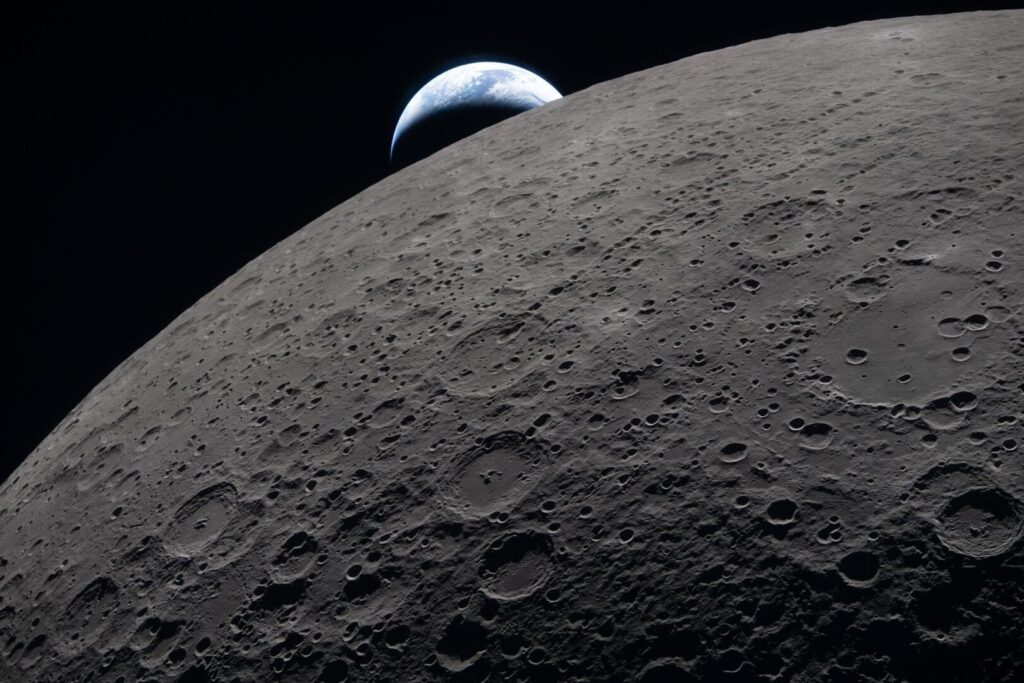
Image by Artemis II crew (2026)
Focus and Reflection Questions
- What is your first reaction to these images (and the others) from the Artemis II mission? How do the images and the mission itself make you feel? Why?
- Does the human ingenuity, such as that on display in the Artemis II mission increase your hope in the human race to overcome our differences to unite for the common good? Why or why not? How can one of the peaks of human achievement, space exploration, honor and glorify God?
- Astronauts often speak about how they were completely stunned by the wholly unique experience of viewing an alien landscape like the moon and seeing the entire planet Earth before them, despite intense preparation. They are often at a loss of words to describe the simultaneous feeling of begin awestruck at the strangeness of the sight, admiration of the beauty of the cosmos, and a deep longing for our home planet Earth. They even speak of a new understanding of just how uniquely suited the Earth is for life and, specifically, for us. This phenomenon is so common among astronauts it has been named the “overview effect.” Artemis II crew member, Christina Koch, previously spoke of the experience during her time on the International Space Station (ISS):
“What you realize is every single person that you know is sustained” by the thin band of atmosphere, which is visible in its entirety from space, “Everything else outside of it is completely inhospitable. . . All you see is Earth and you see that we are way more alike than we are different.”
During the Artemis II mission, speaking to Mission Control after coming out of a planned communications blackout while passing on the dark side of the moon, Koch said,
“We will explore. We will build ships. We will visit again. We will construct science outposts. We will inspire — but ultimately, we will always choose Earth. We will always choose each other.”
How does this unique perspective of the Earth and our place in the cosmos by the select few who have witnessed it and the longing for home and communion with one another demonstrate the essential human longing for the transcendental experiences of truth, goodness, beauty, love, and feeling of belonging and of being home? How do these experiences and, specifically the experience of the “overview effect” show the desire for God present in each of our hearts? - Each point of light in this image is a star. Scientists estimate that there around 100–200 billion stars in our Milky Way Galaxy alone, many of them potentially having their own planetary systems. Scientists estimate there are between 100–200 billion galaxies in the observable universe (from our vantage point, only a portion of the universe is even observable to us), with perhaps 2 trillion galaxies in the entire universe, each with an average of around 100–200 billion stars (estimating based on the number of stars in our own galaxy). That means there are around 200 billion trillion stars — 200 sextillion or 200,000,000,000,000,000,000,000 — in the entire universe! These facts place our very existence into stark perspective. We are but a tiny part of the vastness of the universe. And yet, we do exist and are capable of discovering and admiring the beauty and complexity of the universe. How does it make you feel to know that God, who created all the galaxies, stars, and planets in the universe, also created you, and knows and loves you? What do you think should be our response to our Creator in light of the beauty and mystery of His Creation?
- The Artemis II crew was in space on Easter Sunday, approaching the moon for the first time in half a century. They looked out at the Earth and had, perhaps, some small experience of God’s unique perspective on creation and mankind — in a way, every single living human being was visible to them at once. Sometimes it takes a shift in perspective to understand difficult things. We realize we are not aware of or even capable of grasping the bigger picture. In the Book of Job God speaks to us about this sense of perspective, demonstrating His divine creative power and humbling limitations of human knowledge and understanding with a series of rhetorical questions that begin:
Where were you when I founded the earth? Tell me, if you have understanding.
Who determined its size? Surely you know? Who stretched out the measuring line for it?
Into what were its pedestals sunk, and who laid its cornerstone,
While the morning stars sang together and all the sons of God shouted for joy? . . .
Have you ever in your lifetime commanded the morning and shown the dawn its place?
For taking hold of the ends of the earth, till the wicked are shaken from it? (Job 38:4–7, 12–13)
In what way does the unique perspective witness by the Artemis II crew shed light on God’s perspective of creation and, specifically on the human experience? How might it help us better understand difficult concepts like the redemptive suffering and Christ’s suffering, Death, and Resurrection and how they serve the greater glory of God? - Consider for a moment how the goal of science and faith are the same: to understand the universe around us it really is. How can the different methods used by science and theology to achieve this goal complement one another to enrich our understanding? What do each uniquely contribute? What can faith tell us that science cannot?
Answers
- Accept reasoned answers.
- Shared experiences of human ingenuity, such as the Artemis II mission, show that the conflicts and differences that often seem to run so deep that we couldn’t possibly overcome them, are, in fact, surmountable, when we work together for a common good and, most importantly, when we cooperate with the grace of God and strive to live according to our purpose. All examples of the peak of human achievement, when truly good in and of themselves, far from serving to glorify only ourselves, uses the gifts of our intellects, will, and the resources of the earth that God has created, to honor and glorify Him. It is for this reason that God created all things and gave them to us to have dominion over — to use for the good to show forth His love and goodness back to all of creation.
- When we encounter anything that is truly good, truly true, and truly beautiful, such as what was profoundly witnessed by the Artemis II crew, we are faced in no uncertain terms with the reality that truth, goodness, beauty, love, and a sense of belonging and of being home are those things that truly fulfill us, and are, ultimately, reflections of God Himself, who alone can satisfy perfectly. We naturally desire these things deep in our heart, and, thus, we naturally desire God.
- Accept reasoned answers. Help your students come to recognize that despite the vastness of the universe, the fact that God created each of us, knows each of us intimately, and love each of us unconditionally should at once be humbling and also fill our hearts with comfort and joy. Our God, who made all things, has prepared a place for us to live, grow, be loved by Him and by others, and to discover and learn about Him and His love for us. Some students, however, may express feelings of loneliness or isolation when confronted with the vastness of the universe, or that the vastness of the universe emphasizes our relative insignificance. While an understandable feeling, we know from our Faith that God has not and does not leave us alone, and, in fact, came to dwell among us and die for our salvation so we can live eternally with Him. Our response to God should be one humility and gratitude, but also of immense awe and wonder at the beauty and majesty of His creation and what and how He has made all things.
- God’s perspective, as He dramatically told Job in the Old Testament, is so different from our own. Whereas we may only see or understand a small part of the universe and are, ultimately, unable on our own to come to bigger conclusions about the meaning of certain things, God is God, the creator of all things, who possess all knowledge. Therefore, His perspective is one of full understanding and of meaning. Understanding this difference helps us to place our trust in God, even when it is difficult to do so. This truth applies especially so when it comes to the experience of suffering. While we may not always understand why we are experiencing some particular suffering, we can know that we can unite our sufferings to Christ’s own suffering so that it becomes redemptive, not only for ourselves, but for the Church and the whole world. The same, then is true, for Christ’s suffering, Death, and Resurrection — in God’s divine plan, He knew from the beginning that His Son’s sacrifice on the Cross and Resurrection from the dead would be the ultimate act of love and would redeem the world from sin.
- Space exploration and other scientific and technological endeavors can be great reminders of our place in the universe and the limits of human understanding, as well as of the great blessings that God has bestowed upon to be able to explore, understand (what we are able to understand), and be creative. The different means and tools of science can discover the what and how of the universe — what things are and in many cases how those things came to be and are interrelated with one another. Faith reveals to us the why of things — why things are the way they are and the meaning of them. Together, these two methods of coming to understand the universe as it is, create a more full, beautiful, and meaningful portrait of existence.
