
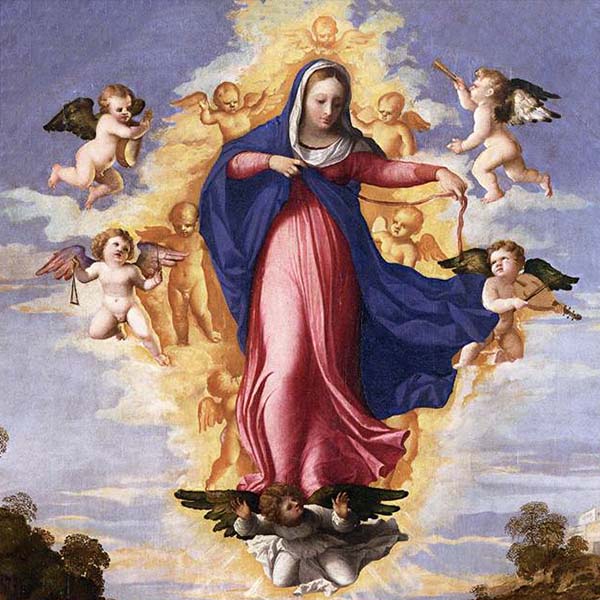
Mother’s Day calls to mind the gratitude and love that we have for our mothers. Motherhood forms a powerful and unbreakable bond between mother and child, and throughout our lives we remember the countless sacrifices our mothers have made for us so our lives can flourish. Scripture often uses the image of a mother’s love as a way to illustrate the depth of God’s nurturing love for each of us. This image has been made all the more powerful by the miracle of the Incarnation, in which God who created the heavens and the earth submitted Himself to being conceived by the power of the Holy Spirit in the womb of the Blessed Virgin Mary, truly becoming her Son. As a child, Our Lord Jesus Christ submitted Himself in obedience to His father and mother, giving us a perfect example to follow. From the Cross, He placed the whole world under the motherly care and protection of Mary. This Mother’s Day let us remember the wonderful and miraculous gift of motherhood as we experience it both in our own families and in the universal Church. Let us imitate Christ and show our mother how much we love her!
In this lesson your students will:
Learn why Catholic Tradition gives Mary and the Church the title “Mother”.
Consider a mother’s role in God’s plan for the family.
Discuss what it means to honor our parents.
Explore Christ’s obedience to His own Mother and ways we can imitate Him.
NOTE: For younger students a Mary, the Mother of God read-aloud story and coloring page activity is included in this lesson.

First, have your students read over the Gospel passages in the Motherhood in Scripture warm-up activity and consider the reflection questions.
Then, give your students Catechism of the Catholic Church nos. 169, 501, 511, 2200, 2215 & 2217, and have them watch the video titled Why Catholics Call Mary Their Mother, found at the following link: SophiaOnline.Org/WhyCatholicsCallMaryMother
Have students reflect on what they read in the Catechism and compare it with what they learned in the video using the focus and reflection questions.
Have your students share their answers with the class if you are teaching virtually or write them out if they are studying from home. Consider having your students write a letter to their mothers thanking them for the gift of life and the sacrifices they have made for them.
Finally, have your students end by praying the Prayer for Parents.
Younger Student Instructions:
First, have your students read over the Gospel passages in the Motherhood in Scripture warm-up activity and consider the reflection questions.
Then, have your students watch the video titled Why Catholics Call Mary Their Mother, found at the following link: SophiaOnline.Org/WhyCatholicsCallMaryMother
Have your students read about Mary from the Mary, the Mother of God read-aloud page, and then color the picture of Mary.
Have your students write a letter to their mothers thanking them for the gift of life and the sacrifices they have made for them.
Finally, have your students end by praying the Prayer for Parents.
Answer Key
Focus and Reflection Questions
We call the Church our Mother because it is through her that we receive the life of faith. Accept reasoned answers. The Church’s role as mother is accomplished through the Sacraments, especially Baptism, by which we are born into the faith, and through her teachings, etc.
“Jesus is Mary’s only son, but her spiritual motherhood extends to all men whom indeed he came to save.” We have been made brothers of Christ by our Baptism, and so we too can call Mary “mother.”
Because “By her obedience she became the new Eve, mother of the living.” Mary’s title “mother of the living” is significant because Eve was first given this title in the Garden of Eden, but through her disobedience all mankind fell into sin. Mary, by her “yes” to God’s invitation, became the mother of Our Savior and so the mother of all those He would redeem by His Passion, Death, and Resurrection.
“Observing the fourth commandment brings its reward: ‘Honor your father and your mother, that your days may be long in the land which the LORD your God gives you.’ Respecting this commandment provides, along with spiritual fruits, temporal fruits of peace and prosperity.” Accept reasoned answers.
Failing to observe the Fourth Commandment “brings great harm to communities and to individuals.” Accept reasoned answers.
“True Respect for parents (filial piety) derives from gratitude toward those who, by the gift of life, their love and their work, have brought their children into the world and enabled them to grow in stature, wisdom, and grace.” Accept reasoned answers.
Accept reasoned answers. Our parents are an image of God’s love in our lives, and our first teachers. Christ Himself, our model, who perfectly pleased God in all He did, was obedient to His earthly parents when He was a child.
He says that when we love Mary we are led to a greater love of Jesus. Loving the people Jesus loves increases and amplifies our love for Him.
Because just as the moon is illuminated by the sun, and reflects its light, so Mary reflects Christ’s light and love into the world. She always points us to God, and when we love her, our love for God is amplified.
When He was on the Cross, Jesus gave Mary to His disciples, and to us, as our Mother. This means we have to have a relationship with her if we want to know Jesus and follow Him. The Catechism teaches us that Mary is our Mother and model, and that her motherhood “extends to all men.” Accept reasoned answers.
We use cookies to improve your experience on our site. By using our site, you consent to cookies.
This website uses cookies
Websites store cookies to enhance functionality and personalise your experience. You can manage your preferences, but blocking some cookies may impact site performance and services.
Essential cookies enable basic functions and are necessary for the proper function of the website.
Name
Description
Duration
Cookie Preferences
This cookie is used to store the user's cookie consent preferences.
30 days
Google Tag Manager simplifies the management of marketing tags on your website without code changes.
Name
Description
Duration
cookiePreferences
Registers cookie preferences of a user
2 years
td
Registers statistical data on users' behaviour on the website. Used for internal analytics by the website operator.
session
Statistics cookies collect information anonymously. This information helps us understand how visitors use our website.
Google Analytics is a powerful tool that tracks and analyzes website traffic for informed marketing decisions.
Contains information related to marketing campaigns of the user. These are shared with Google AdWords / Google Ads when the Google Ads and Google Analytics accounts are linked together.
90 days
__utma
ID used to identify users and sessions
2 years after last activity
__utmt
Used to monitor number of Google Analytics server requests
10 minutes
__utmb
Used to distinguish new sessions and visits. This cookie is set when the GA.js javascript library is loaded and there is no existing __utmb cookie. The cookie is updated every time data is sent to the Google Analytics server.
30 minutes after last activity
__utmc
Used only with old Urchin versions of Google Analytics and not with GA.js. Was used to distinguish between new sessions and visits at the end of a session.
End of session (browser)
__utmz
Contains information about the traffic source or campaign that directed user to the website. The cookie is set when the GA.js javascript is loaded and updated when data is sent to the Google Anaytics server
6 months after last activity
__utmv
Contains custom information set by the web developer via the _setCustomVar method in Google Analytics. This cookie is updated every time new data is sent to the Google Analytics server.
2 years after last activity
__utmx
Used to determine whether a user is included in an A / B or Multivariate test.
18 months
_ga
ID used to identify users
2 years
_gali
Used by Google Analytics to determine which links on a page are being clicked
30 seconds
_ga_
ID used to identify users
2 years
_gid
ID used to identify users for 24 hours after last activity
24 hours
_gat
Used to monitor number of Google Analytics server requests when using Google Tag Manager
1 minute
SourceBuster is used by WooCommerce for order attribution based on user source.
Name
Description
Duration
sbjs_current
Traffic origin information for the visitor’s current visit to your store
session
sbjs_first_add
Timestamp, referring URL, and entry page for your visitor’s first visit to your store (only applicable if the visitor returns before the session expires)
session
sbjs_current_add
Timestamp, referring URL, and entry page for your visitor’s current visit to your store
session
sbjs_migrations
Technical data to help with migrations between different versions of the tracking feature
session
sbjs_session
The number of page views in this session and the current page path
30 minutes
sbjs_udata
Information about the visitor’s user agent, such as IP, the browser, and the device type
session
sbjs_first
Traffic origin information for the visitor’s first visit to your store (only applicable if the visitor returns before the session expires)
By creating an account, you agree to receive personalized emails (e.g., event reminders, free resources, & more) from Sophia Teachers at the email address provided. Consent is not a condition of any purchase. View Terms & Privacy.