
Every Catholic Church on earth is a truly sacred space. The Catechism states that “Christians construct buildings for divine worship. These visible churches are not simply gathering places but signify and make visible the Church living in this place, the dwelling of God with men reconciled and united in Christ” (CCC 1180).
Since physical Catholic churches truly house God the Son in the Most Holy Eucharist, it follows that those who love God would desire to construct for Him the most beautiful spaces possible, to fittingly reflect His sacred and real presence.
Through the ages, Christian nations constructed for God’s glory marvels of art and architecture that even today take our breath away and leave us awestruck.
In this lesson, students will encounter the magnificent Basilica of St. Peter in Rome, and learn about some of the artistic and architectural marvels it contains. They will then reflect on their experience of it, and discuss how the architectural beauty of the basilica affirms, celebrates, or illuminates our Holy Catholic Faith.
The Call of Beauty: Sacred Spaces: St Peter’s Basilica
Lesson Overview
Upper Elementary Lesson Materials
Download all PDFsTeacher Directions
Resources
- Virtual Tour of the Basilica of Saint Peter: SophiaOnline.org/SaintPetersBasilica
- Documentary on the beauty of St. Peter’s Basilica: SophiaOnline.org/InsideStPeters
Activities:
- Begin by asking your students if they have heard of or seen images of St. Peter’s Basilica in Rome. Invite students to share what they know about St. Peter’s Basilica with the class.
- Then explain that a basilica is a large Church, traditionally built in the shape of a cross, that has special uses, or privileges granted by the bishop. Among the basilicas of the world, there are a handful that stand as preeminent, known as the major basilicas. St. Peter’s is the largest of the major basilicas, and is considered by many to be the most beautiful and magnificent structure ever built. For Catholics, it is special for many reasons, not least of which is because it is constructed on the site where St. Peter, the first pope, was martyred under Emperor Nero’s rule.
- Inform your students that today you will virtually explore the interior of St. Peter’s together, and learn about some of the impressive artistic features of the Church.
- Next, project for the class the virtual tour of St. Peter’s Basilica, which can be found at: SophiaOnline.org/SaintPetersBasilica. View with them the Nave (#5 on the menu), then the Altar (#2), and finally the Apse (#1). As you enter each view, and slowly move the perspective, explain the following:
- Nave: The nave is the long, rectangular space in a Church, usually filled with pews for the faithful. The word “nave” stems from the Latin navis, which means ship. Why do you think this space in the Church is named after a ship? Accept reasoned answers. To remind us that the Church, like the Ark of the Old Testament, is the earthly vessel of our salvation. We are pilgrims bound for Heaven, and the Church on earth was established by Christ as our means of getting there. The Church is a haven and place of refuge in the storms of life, and this reality is reflected in traditional Catholic architecture.
- Altar: The altar is the most vital architectural element of any Catholic Church, and is of central importance in the Liturgy. The Catechism states, “The altar of the New Covenant is the Lord's Cross, from which the sacraments of the Paschal mystery flow. On the altar, which is the center of the church, the sacrifice of the Cross is made present under sacramental signs. The altar is also the table of the Lord, to which the People of God are invited” (CCC 1182). Because Christ Himself is offered on the altar under the appearance of bread and wine during Mass, we bow and show reverence toward the altar when we are in Church.
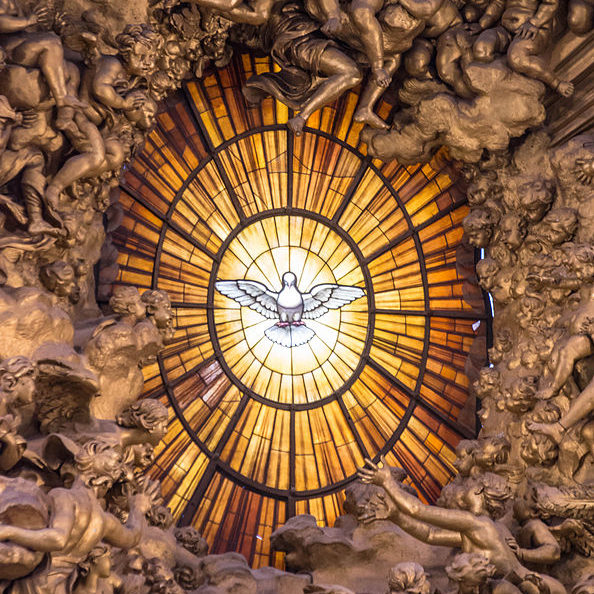
- Apse: The apse is the sanctuary end of a Church, usually semicircular. In St. Peter’s, and most basilicas, the apse is a rounded section behind the altar, with a high ceiling, and in which is placed the bishop’s throne and seats for the other clergy. The apse in St. Peter’s Basilica contains a particularly beautiful depiction of the Holy Spirit descending into the Church on wrought clouds of gold and shafts of golden light.
- When you have finished the tour, ask your students to share what visually struck them most about the interior of St. Peter’s Basilica, and why. Answers will vary.
- Next, inform your students that they will be watching a documentary on the significant features and history of St. Peter’s. Create a prayerful atmosphere, then play for your students the video documentary on St. Peter’s Basilica from EWTN, which can be found at: SophiaOnline.org/InsideStPeters.
- When the video has played, have students answer the reflection questions either silently or in small groups.
- When they have finished, call on students or groups to share their answers with the class as part of a class discussion on how the experience of beauty in Church aids our prayer and worship of God, sharing your own thoughts and reflections as you work through the questions with them.
Answer Key:
Reflection Questions
- Accept reasoned answers.
- Accept reasoned answers.
- Accept reasoned answers. The chair of Peter represents his Christ-given authority over the Church, which has been handed down in an unbroken line to the present. The knowledge that the basilica is built upon the site of St. Peter’s martyrdom, that it is built over his tomb, and that it contains his original bishop’s chair, adds layers of symbolism that help deepen our faith and strengthen our piety. In St. Peter’s basilica, through the architecture and relics, the faithful become intimately connected to the founding of Christ’s Church on earth, and to the One who founded it upon Peter, the rock.
- Accept reasoned answers.
- Accept reasoned answers. Through wonder at its impressive size, magnificent artistic beauty, and architectural splendor, the experience of St. Peter’s Basilica directs our attention and our hearts to God, and draws our prayer to Him. Wherever we look we are reminded of the life of Christ, the founding of His Church, the saints who lead us to Him, and His Sacrifice offered for our salvation which is perpetually represented at Holy Mass.
