
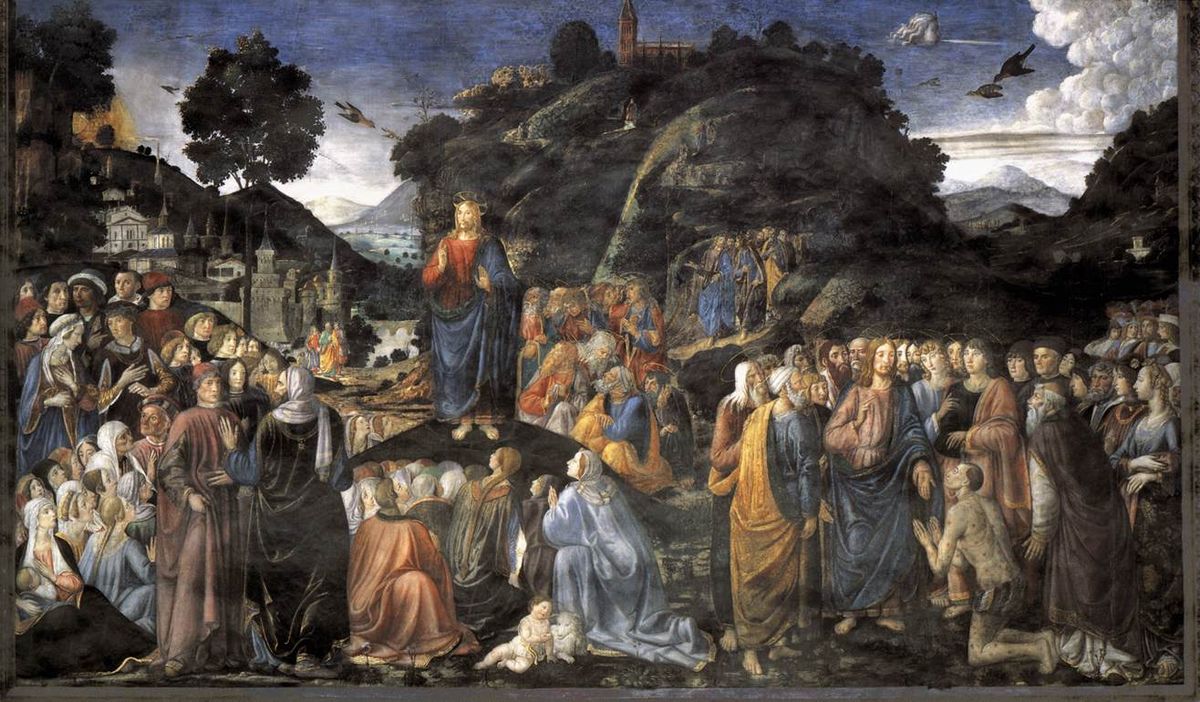
In this week’s Gospel passage, Jesus teaches the Beatitudes in the Sermon on the Mount. The Beatitudes provide a road map to sainthood for the faithful follower of Jesus. Though we may gain little reward in this life by following Christ’s teaching, our victory comes in the end and is nothing short of the Kingdom of God itself. Students will learn about sainthood and how to look to the saints of Heaven as examples of holiness.

Have your students read the Gospel passage, or read it aloud to your students, and then answer the focus questions.
Review and discuss the answers when they have completed the focus questions.
Next, have your students read about the Solemnity of All Saints.
Then, arrange students into groups of three or four. Have each group complete the Lives of the Saints Activity. Each group should choose two saints and look up their biographies either online or in a lives of the saints book.
Have each group choose one of the saints they studied, stand and briefly present their findings, specifically how that saint loved and served God and how the saint loved and served others.
From a mountain. This is the beginning of Jesus’ most famous teaching, the Sermon on the Mount.
The blessed are the poor in spirit, those who mourn, the meek, those who hunger and thirst for righteousness, the merciful, the clean of heart, the peacemakers, and those who are persecuted for Christ’s sake. Their reward is the Kingdom of Heaven,comfort, the land, satisfaction, mercy, seeing God, being a child of God, and the Kingdom of Heaven.
They must be marked with God’s seal. They come from all of the tribes of Israel.
The saints in Heaven. They are praising and worshipping God. They came from every nation and people on the earth.
The Beatitudes teach us how to be saints, how to be like Christ. By living the Beatitudes, we are faithfully living the Christian life and seeking holiness.
Directions
Read the Gospel passage aloud to your students as they follow along. Then discuss the focus and reflection questions with them as a class.
Then, read aloud to your students, or have them read on their own, the Solemnity of All Saints.
Next, arrange students into groups of three or four. Have each group complete the Lives of the Saints Activity. Each group should choose a saint and look up his or her story either online or in a lives of the saints book. A list of saints’ biographies can be found at the following link: SophiaOnline.org/SaintCards.
Afterwards, you may choose to have each group choose one of the saints they studied and briefly present their findings.
We use cookies to improve your experience on our site. By using our site, you consent to cookies.
This website uses cookies
Websites store cookies to enhance functionality and personalise your experience. You can manage your preferences, but blocking some cookies may impact site performance and services.
Essential cookies enable basic functions and are necessary for the proper function of the website.
Name
Description
Duration
Cookie Preferences
This cookie is used to store the user's cookie consent preferences.
30 days
Google Tag Manager simplifies the management of marketing tags on your website without code changes.
Name
Description
Duration
cookiePreferences
Registers cookie preferences of a user
2 years
td
Registers statistical data on users' behaviour on the website. Used for internal analytics by the website operator.
session
Statistics cookies collect information anonymously. This information helps us understand how visitors use our website.
Google Analytics is a powerful tool that tracks and analyzes website traffic for informed marketing decisions.
Contains information about the traffic source or campaign that directed user to the website. The cookie is set when the GA.js javascript is loaded and updated when data is sent to the Google Anaytics server
6 months after last activity
__utmv
Contains custom information set by the web developer via the _setCustomVar method in Google Analytics. This cookie is updated every time new data is sent to the Google Analytics server.
2 years after last activity
__utmx
Used to determine whether a user is included in an A / B or Multivariate test.
18 months
_ga
ID used to identify users
2 years
_gali
Used by Google Analytics to determine which links on a page are being clicked
30 seconds
_ga_
ID used to identify users
2 years
_gid
ID used to identify users for 24 hours after last activity
24 hours
_gat
Used to monitor number of Google Analytics server requests when using Google Tag Manager
1 minute
_gac_
Contains information related to marketing campaigns of the user. These are shared with Google AdWords / Google Ads when the Google Ads and Google Analytics accounts are linked together.
90 days
__utma
ID used to identify users and sessions
2 years after last activity
__utmt
Used to monitor number of Google Analytics server requests
10 minutes
__utmb
Used to distinguish new sessions and visits. This cookie is set when the GA.js javascript library is loaded and there is no existing __utmb cookie. The cookie is updated every time data is sent to the Google Analytics server.
30 minutes after last activity
__utmc
Used only with old Urchin versions of Google Analytics and not with GA.js. Was used to distinguish between new sessions and visits at the end of a session.
End of session (browser)
SourceBuster is used by WooCommerce for order attribution based on user source.
Name
Description
Duration
sbjs_session
The number of page views in this session and the current page path
30 minutes
sbjs_udata
Information about the visitor’s user agent, such as IP, the browser, and the device type
session
sbjs_first
Traffic origin information for the visitor’s first visit to your store (only applicable if the visitor returns before the session expires)
session
sbjs_current
Traffic origin information for the visitor’s current visit to your store
session
sbjs_first_add
Timestamp, referring URL, and entry page for your visitor’s first visit to your store (only applicable if the visitor returns before the session expires)
session
sbjs_current_add
Timestamp, referring URL, and entry page for your visitor’s current visit to your store
session
sbjs_migrations
Technical data to help with migrations between different versions of the tracking feature
By creating an account, you agree to receive personalized emails (e.g., event reminders, free resources, & more) from Sophia Teachers at the email address provided. Consent is not a condition of any purchase. View Terms & Privacy.